
Humbertown Jewellers has been helping clients discover natural diamonds and coloured gemstones since 1980. At…
Read More →
Humbertown Jewellers has been helping clients discover natural diamonds and coloured gemstones since 1980. At…
Read More →
Dull, tired skin is one of the most common signs of ageing skin, and also…
Read More →
veryday luxury has long come with unwritten rules. Jewelry is often removed before workouts, packed…
Read More →
This month’s round-up spans the city’s most exciting openings, from a South Korean pot rice…
Read More →
How to live a luxurious lifestyle In a world that often seems to move at…
Read More →
If you’ve been curious about what’s shaping modern life, you’re in the right place. The…
Read More →Around 30 million bottles of Johnnie Walker are sold in Duty Free each year – but it was a single, $130 bottle of Blue Label that set Frans Op den Kamp on the road to two decades of collecting.
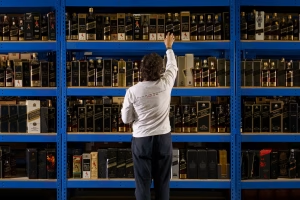
The result, which goes under the hammer with Whisky Auctioneer next week, is the largest and most comprehensive Johnnie Walker collection ever put up for sale, a cache featuring more than 3,200 bottles and miniatures as well as over 1,000 pieces of advertising and memorabilia.
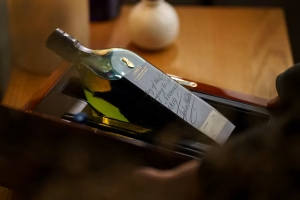 “I have always had an innate collector’s instinct – from childhood Smurfs to beer cans from around the world,” says Op den Kamp. “When I turned to whisky, I bought and tried a wide variety of single malts and blends. Johnnie Walker stood out for its profound history and unmatched global footprint. Everywhere I traveled for work – from international airport lounges to remote bars or high-end restaurants – the iconic Striding Man was a constant presence, offering regional editions unavailable back home.”
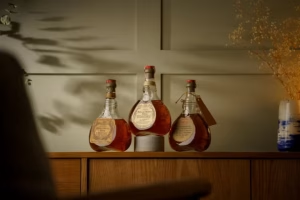
The archive spans more than a century of Johnnie Walker history, from early 20th-century Old Highland Whisky bottlings, and the birth of the iconic “Striding Man”, through to ultra-rare modern releases such as the 1805 Celebration Blend (auction estimate £5,000 – £10,000), which was gifted to 200 individuals to celebrate the 200th anniversary of John Walker’s birth.
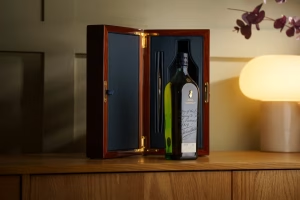
 One of Op den Kamp’s most prized finds was the Johnnie Walker Jenson Button Vodafone McLaren Mercedes Signature Blend (auction estimate £5,000 – £7,000), which was one of just 25 produced. Housed in a custom carbon-fibre case embedded with an authentic wheel nut from the 2011 Hungarian Grand Prix, it was originally released through the Shanghai Johnnie Walker House.
“After missing out when it was first released, it took years of searching before I finally secured it via a private sale in London,” he says. “I am hoping a F1 fan may be interested in this.”
 “Johnnie Walker’s history is, in many ways, the history of Scotch whisky becoming a global drink in the twentieth century,” says whisky historian Nick Morgan, author of the Johnnie Walker bicentennial history, A Long Stride: The Story of the World’s No.1 Scotch Whisky. “And what makes Frans’ collection so remarkable is the way it brings that history together in physical form to tell it.”
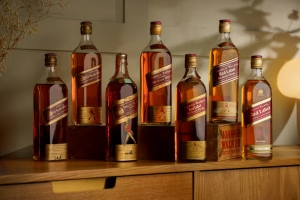
While competition will inevitably be fierce for the big-ticket Blue Labels, Morgan highlights the extensive range of Red and Black Label vintages in the archive, too, as a valuable insight into how distilling and maturation techniques have evolved over the years. “To be able to come in and pick up forty years’ worth of Black or Red Label in one go is pretty unique.”
 With Morgan, I taste five Black Labels from the collection, stretching from the noughties to the 1960s, “which was when all the distilleries expanded and you see the changes in the ways in which whisky is made.” The sixties blend – which was under cork rather than screwcap – “is made from whisky distilled in the fifties, so it’s still in the old style,” he says, “with that tongue-coating quality, that mouthfeel that’s one of the signs of an old-fashioned whisky.” The 20th-century Black Label “is much cleaner and fresher”, partly thanks to the absence of paxarette, a sherry concentrate which was used to treat Scotch whisky casks until it was banned in 1990.
Another key lot in the collection, says Morgan, is the complete set of Johnnie Walker Director’s Blends (auction estimate £3,000 – £5,000). Produced for just six years, in the late noughties and teens, these 500-bottle small-batch blends were gifted to friends of the company and never made available for public sale. “Because they’re not that well-known most people probably don’t really understand the value in those bottles, but they’re just fantastic,” says Morgan. “It’s incredibly rare to be able to acquire all six.”
 One of his picks from the memorabilia is a framed print of the very first poster to depict Johnnie Walker’s iconic ‘striding man’. “That is a very important piece,” says Morgan. “It’s only the second – aside from the print I own – that I have ever seen.”
I have met significant whisky collectors before who – rather tragically – have never opened or tasted a thing. But Op den Kamp has enjoyed “a significant number of bottles,” in his collection over the years, he says. “My philosophy has always been that part of collecting something like this is tasting the whisky, not just viewing it on a shelf. Early on, someone advised me to buy three bottles of every edition – one to drink, one to hold, and one to sell.’
“Parting with the collection is certainly not easy,” he says. “But I feel I have achieved what I set out to do. This marks the definitive conclusion of my whisky-collecting journey, though not my whisky appreciation!”